RustClash KYC Verification: How Long, Why and How to Pass First Time
RustClash KYC usually takes anywhere from a few hours to a couple of days, depending on the queue and how clean your documents are. The fastest way through is to submit clear, matching documents the first time, and ideally to do it before you need a withdrawal. A rejected upload is the most common reason KYC drags on.
Here's what triggers KYC on RustClash, what you'll need and how to avoid the classic rejections.
What triggers KYC on RustClash
You don't need ID to sign up or play. KYC comes up when:
- You withdraw a card deposit as crypto. Card payments can be charged back; crypto can't. Verification protects against stolen-card fraud.
- You want the level-5 case. It's gated behind KYC.
- You want to join rain before reaching level 10. Rain eligibility is KYC or level 10+.
- Larger or unusual withdrawals. Standard anti-money-laundering practice.
- Account security concerns. For example, logins from many locations or payment name mismatches.
How long it takes
There's no published guaranteed time, so treat these as realistic expectations:
| Situation | Typical wait (illustrative) |
|---|---|
| Clear documents, quiet period | Hours to about a day |
| Busy period (weekends, events) | One to a few days |
| Documents rejected and resubmitted | Restart the wait each time |
| Extra checks (source of funds) | Longer, case by case |
The biggest controllable factor is document quality. A blurry photo can cost you days.
What you'll need
Photo ID
A valid government ID:
- Passport
- Driving licence
- National ID card
It must be in date, show your full name, date of birth and photo clearly.
Selfie or liveness check
Many KYC systems ask you to take a selfie or short video, sometimes holding your ID. Follow the on-screen prompts; good light and a plain background help.
Proof of address (sometimes)
If asked:
- Bank statement or utility bill
- Dated within the last few months (often 3)
- Showing your full name and address matching your account
Proof of payment method (sometimes)
For card deposits, you might be asked for a photo of the card with middle digits covered, or a bank statement showing the deposit. Cover sensitive digits as instructed.
Step-by-step: submitting KYC
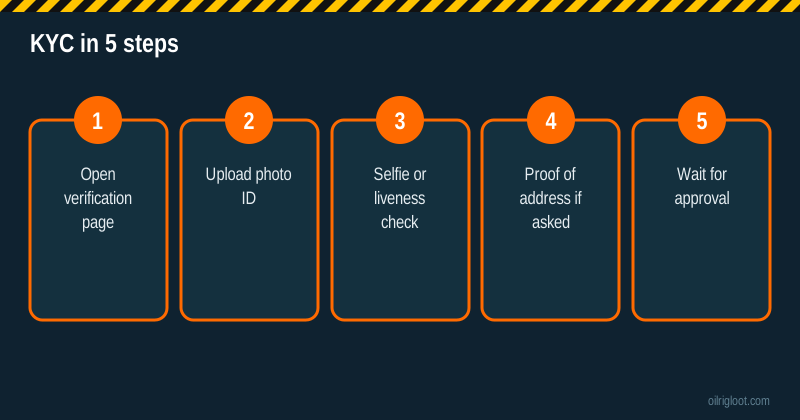
- Go to your profile or settings and find Verification (or follow the prompt in the cashier).
- Choose your document type and country.
- Upload or photograph the front (and back if required).
- Complete the selfie/liveness step if asked.
- Upload proof of address if requested.
- Submit and wait for an email or on-site notice.
Don't submit the same documents repeatedly while you're waiting. It can put you back in the queue.
Why KYC gets rejected (and fixes)
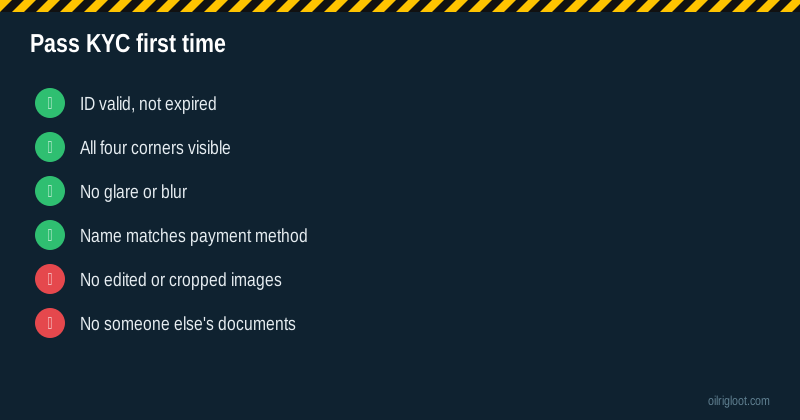
| Rejection reason | Fix |
|---|---|
| Blurry or dark photo | Daylight, steady hands, no zoom |
| Glare on ID | Tilt slightly away from light |
| Cropped edges | All four corners in shot |
| Expired ID | Use a valid document |
| Name mismatch | Your account and payment details must be in your name |
| Old proof of address | Use one dated within the required window |
| Edited image | Upload originals, no filters or edits |
Privacy: is it safe to send ID?
KYC is standard across gambling and crypto. Still, be sensible:
- Upload only on the official site. Never send documents to anyone by Discord, Steam chat or email who says they're support.
- Read the privacy policy so you know how documents are stored.
- Remember RustClash isn't licensed, so there's no gambling regulator overseeing its data handling. That's a consideration before you hand over ID.
If you're uncomfortable sharing ID, the simplest route is to avoid triggers: deposit and withdraw in crypto, skip the level-5 case and don't rely on rain before level 10. Larger withdrawals can still require checks.
KYC and restricted locations
KYC also confirms where you live. If your documents show an address in Idaho, Montana, Michigan, Nevada or Washington, or in a country where RustClash doesn't operate, verification can lead to the account being closed. Using a VPN to sign up from a restricted place and then submitting real documents is a common way people lose balances. Don't do it.
What if KYC is taking forever?
- Check your email (including spam) for a request for more documents.
- Check the verification page for a status or rejection note.
- Contact live chat with your account details and ask for the status.
- If you've been asked for something you don't have, explain and ask what alternatives are accepted.
Tips from players who've done it
- Do it on your phone in daylight: phone cameras usually beat webcams.
- Use the same name format as your ID on every payment method.
- Do it right after your first card deposit, not after a big win, so it doesn't feel like a stall.
KYC vs sweepstakes redemption in the US
On the US sweepstakes version, redeeming Gems for prizes can also require verification, because prize redemptions must go to eligible people in eligible states. The documents are the same kind: photo ID and sometimes proof of address. If you plan to redeem anything meaningful, verify early. See Gold Coins and Gems explained.
Does KYC ever happen twice?
It can. Verification isn't always one-and-done. You might be asked again if your ID expires, you change address, you add a new payment method in a different name format, or you make an unusually large withdrawal that triggers a source-of-funds check. Source-of-funds checks ask where the money you're gambling with came from, for example payslips or bank statements. They're more common at licensed casinos but can appear anywhere that follows anti-money-laundering practice. Treat them as routine, and if you're not comfortable sharing that information, that's a clear sign the amount you're playing with is too high for you.
A made-up example of good timing
Invented example: you deposit $50 by card on Monday and decide to verify right away. You upload a clear driving licence photo and a selfie that evening; the verification is approved on Tuesday afternoon. On Saturday you're up and request a crypto withdrawal; it goes straight to processing with no ID request because you're already verified. A friend who deposited the same way but waited until Saturday to verify spends the weekend waiting instead.
What happens after you're verified
Once approved, you'll usually see a "verified" status on your profile. From then on:
- Card-to-crypto withdrawals won't stall on ID.
- The level-5 case unlocks (it needs KYC).
- You can join rain without waiting for level 10.
- Routine withdrawals usually go straight to processing.
Keep your details current. If you move, change your name or your ID expires, update your verification before your next big withdrawal so it doesn't get held.
KYC myths
"They only ask for ID when you win." KYC triggers are listed in the rules: card-to-crypto withdrawals, the level-5 case, rain below level 10 and larger or unusual withdrawals. Wins often coincide with withdrawals, which is why it feels that way.
"Sending a photo of my ID lets them steal my identity." Any site holding your data is a risk, which is why you should only upload through the official site and read the privacy policy. It's the same process crypto exchanges and licensed casinos use.
"I can use a friend's ID if mine's expired." No. That's fraud, and it will get the account closed.
Checklist before you hit submit
- ID is in date and matches the name on your account and payment methods.
- Photo shows all four corners with no glare.
- Proof of address (if asked) is recent and shows your full name and address.
- You're on the official RustClash site, not a link from a DM.
- You've noted the time you submitted, in case you need to follow up.
If your KYC is rejected
Read the rejection reason carefully, fix exactly that issue and resubmit once. Don't upload a different document type unless asked, and don't argue in chat about the rejection before you've read the note. If you think the rejection is a mistake, ask live chat politely for a manual look and give them the date and time you submitted. Most rejections are photo quality, and most are fixed with one clean resubmission in daylight.
Bottom line
KYC feels like a hurdle, but it protects you as much as the site: it makes it much harder for someone who steals your Steam login to cash out your balance.
Verify once, verify early, verify cleanly, and only ever through the official site's verification page.
Verdict
RustClash KYC typically takes hours to a couple of days, and it's mostly in your hands: submit clear, matching, in-date documents once, ideally before your first withdrawal. Know the triggers (card-to-crypto, level-5 case, rain below level 10, big withdrawals), upload only on the official site, and never try to verify from a restricted state. 18+ only.