How to Verify RustClash Provably Fair Results (Without a Maths Degree)
Provably fair is the one feature that lets you prove a skin site didn't change your result after you bet. RustClash runs it on its games, and verifying a roll takes about five minutes once you know where things are. This guide walks you through it with no maths beyond copy and paste.
A quick warning first: provably fair proves the roll was honest. It doesn't make the game profitable. Every RustClash game still has a published house edge between 6.5% and 10%. Keep that in mind and you'll read the results properly.
The idea in one paragraph
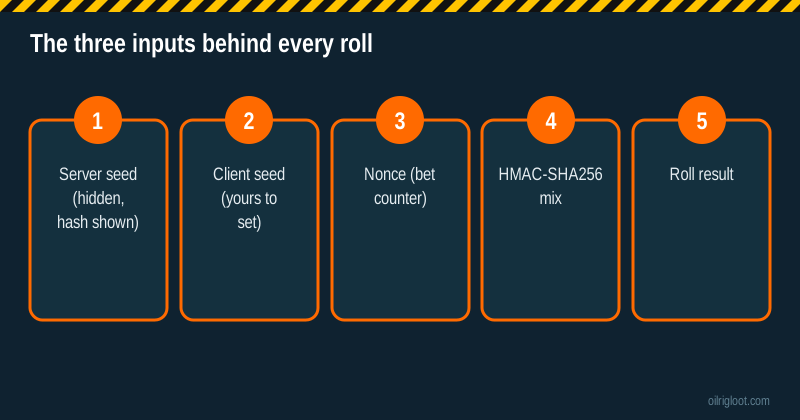
Before you play, RustClash picks a secret server seed and shows you only its hash, a fingerprint created with SHA-256. You pick or accept a client seed. Every bet increases a counter called the nonce. Your result is calculated from all three. Later, you rotate your seeds and the site reveals the old server seed. You check that it produces the same fingerprint you saw earlier, then re-calculate your rolls. If everything matches, the site couldn't have changed the outcome after seeing your bet.
What you need
- A RustClash account (18+, not in Idaho, Montana, Michigan, Nevada or Washington).
- A few bets or case openings to check. The free welcome cases are perfect for practice.
- A SHA-256 tool. The site's verifier works, or any reputable online hash calculator, or a terminal on your PC.
- A notes app to copy seeds into.
Step 1: Save your server seed hash before you play
Open the fairness or provably fair panel in your account or game settings. You should see:
- Server seed (hashed): a long string of letters and numbers.
- Client seed: shorter, editable.
- Nonce: a number, starting from 0 or 1 depending on the site.
Copy the hashed server seed into your notes now. This is the commitment. If the site later shows a different hash, you'll know.
Step 2: Set your own client seed
Change the client seed to something only you would type, like a random word plus numbers. This matters: if only the site chose both seeds, a dishonest site could, in theory, pick combinations in its favour. Your own client seed removes that possibility.
Step 3: Play and note the nonce
Open a case, play a Double round, run a Mines game, whatever you want to test. For each bet you want to check, note the nonce shown in the bet details or history. Bet history usually shows the result alongside the nonce.
Step 4: Rotate seeds to reveal the old server seed
Back in the fairness panel, choose the option to rotate or change your server seed. The site will:
- Reveal the old server seed in plain text.
- Create a new hashed server seed for your future bets.
Copy the revealed old seed into your notes next to the hash you saved in step 1.
Step 5: Check the hash matches
Put the revealed server seed through SHA-256. If you're on a PC with a terminal, a command like `echo -n "SEED" | sha256sum` on Linux or macOS does it. Online tools work too.
Compare the output with the hash you copied in step 1. They must match exactly. If they do, the site committed to that seed before you played and didn't swap it.
Step 6: Re-calculate a roll
Now use the site's verifier (or a script) with the revealed server seed, your client seed and the nonce for a specific bet. It should output the same result you got: the same case item, the same Double colour, the same mine positions.
On most skin sites the method is an HMAC-SHA256 of the client seed and nonce keyed with the server seed, then converted into a number in a range. The exact conversion differs by game. RustClash's own verifier handles that, which is why we recommend using it for the final step and an independent SHA-256 tool for step 5.
What a mismatch would mean
If the hash in step 5 doesn't match, or the re-calculated result in step 6 doesn't match your bet, screenshot everything:
- The original hashed seed (from your notes, with the time you saved it).
- The revealed seed.
- The bet history entry with the nonce and result.
Then contact support with those screenshots. A real mismatch would be serious, and you'd want it on record. In practice, mismatches almost always come from a copy-paste error, a wrong nonce or verifying against the wrong seed pair, so double-check before you panic.
Common mistakes
- Forgetting to save the hash before playing. Without it, you can't prove the seed wasn't changed.
- Mixing up seed pairs. Each rotation starts a new pair. Bets from before the rotation use the old pair.
- Off-by-one nonces. Some sites start at 0, some at 1. Check the bet detail, not your memory.
- Using a site's own hash tool only. Fine for convenience, but for the hash check use an independent tool so you're not trusting the site to check itself.
- Verifying while the server seed is still active. You can only verify after it's revealed through rotation.
Does every RustClash game use provably fair?
Case opening, case battles and the classic in-house games like Double, Mines, Plinko, Tiles, Crash and Upgrader are the typical provably fair games on Clash-family sites. RustClash also offers sports betting, which works differently: odds and results come from real events, not seeds. Provably fair doesn't apply there. Check the fairness page on the site for the current list.
Provably fair vs house edge: why both matter
Think of it like this:
- Provably fair = the dice weren't swapped mid-roll.
- House edge = the dice are made so the house wins slightly more often, and the label tells you by how much.
RustClash's published edge is 10% on cases and battles, 8.65% on Crash, 8.6% on Plinko, 7.5% on Mines and Tiles, 7.3% on Upgrader, 6.67% on Double and 6.5% on Roll. A perfectly fair site with those numbers will still take your money over time. Use our lowest house edge guide if you want to lose more slowly.
A made-up walk-through
To make it concrete, here's an invented example (not real seeds):
- Saved hash before play: 9f2c... (64 characters)
- Client seed you set: oilrig-ak47-2026
- Bet: Double round, nonce 14, landed red
- After rotation, revealed server seed: 3b7e...
- SHA-256 of 3b7e... = 9f2c... ✓ matches
- Verifier with (3b7e..., oilrig-ak47-2026, 14) = red ✓ matches
That's it. Two ticks and you've proved that roll was locked in before you bet.
Doing it with a tiny script (optional)
If you're comfortable with a terminal, a few lines of Python can check the hash and generate the HMAC for any nonce. In plain terms the script does three things: hashes the revealed server seed with SHA-256 so you can compare it with the commitment, then computes an HMAC-SHA256 using the server seed as the key and "client seed:nonce" as the message, then prints the first part of that output as a number. That number is what the game turns into a colour, an item or a mine layout.
The exact message format and conversion vary between sites and even between games, so treat a script as a way to confirm the hash and to compare raw HMAC outputs with the site's verifier, not as a replacement for the official game formulas. If your script and the site's verifier disagree on the HMAC itself, check your message format (colon, dash, order) before assuming anything is wrong.
How often should you verify?
You don't need to check every bet. A sensible routine:
- Once when you start, so you know how the system works and you've seen it pass.
- After any session that felt strange, such as a long run of identical results.
- Whenever you rotate seeds anyway, spot-check one or two bets from the old pair. It takes a minute.
The point isn't to catch the site out every night; it's to know that you could. Sites that publish seeds and let you set your own client seed are taking a public risk if they cheat, which is exactly why the system exists.
What verification can't tell you about item values
One last nuance. In case opening, the roll picks a slot in the case's prize table. Provably fair proves the slot wasn't changed, but the site sets which skins sit in that table and what each is worth in gems. Two cases can both be perfectly fair and still have very different value. Before you open a paid case, check the listed odds and the item values, and compare the expected value with the case price. That's where the 10% case edge actually lives.
Verdict
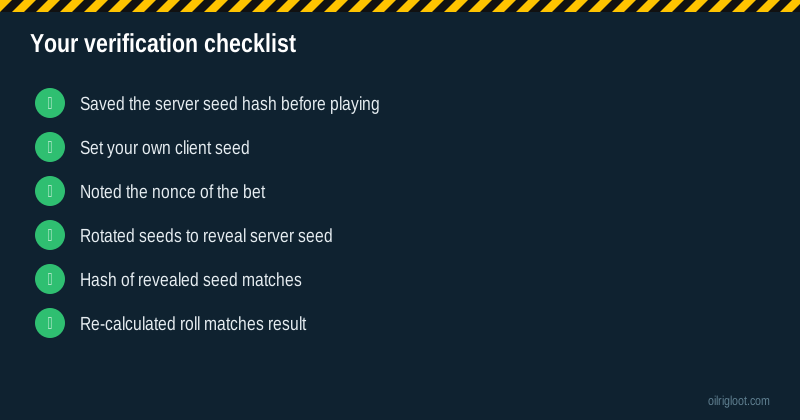
Verifying RustClash's provably fair results is easy once you know the steps: save the hash, set your own client seed, rotate, hash the revealed seed, re-check a bet. Doing it once or twice clears up a lot of "is it rigged?" worries. What it won't do is change the house edge, so play with a budget, 18+ only.
Want to try it with zero risk? The 3 free welcome cases give you real rolls to verify. Just expect mostly scrap; see what the welcome cases contain.