How Do Rust Gambling Sites Make Money?
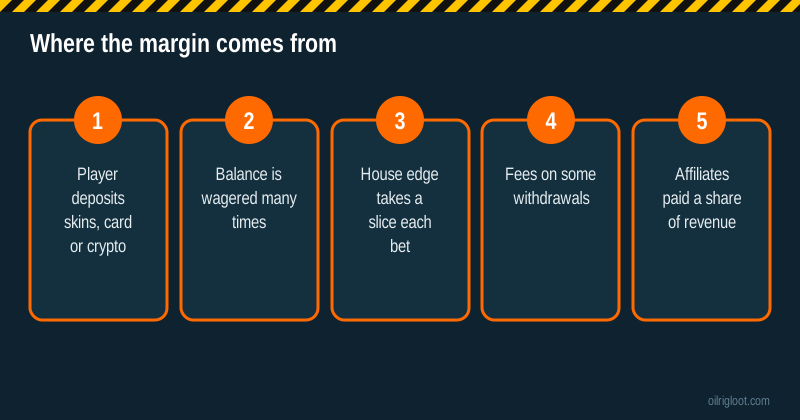
Rust gambling sites make most of their money from the house edge: a small, built-in margin on every case, battle, spin and bet. Any single game can go either way, but across thousands of players and millions of bets that margin turns into a steady, predictable income. On top of that come smaller streams: fees on some withdrawals, the gap between how skins are priced in and out, and money from partners and sister brands. Affiliates, including sites like this one, are paid from that revenue.
We'll use RustClash as the worked example because it publishes its house edge for every game, which makes the maths easy to show. We earn a commission if you sign up through our link, and this page explains exactly where that commission comes from.
1. The house edge, the engine of the whole business
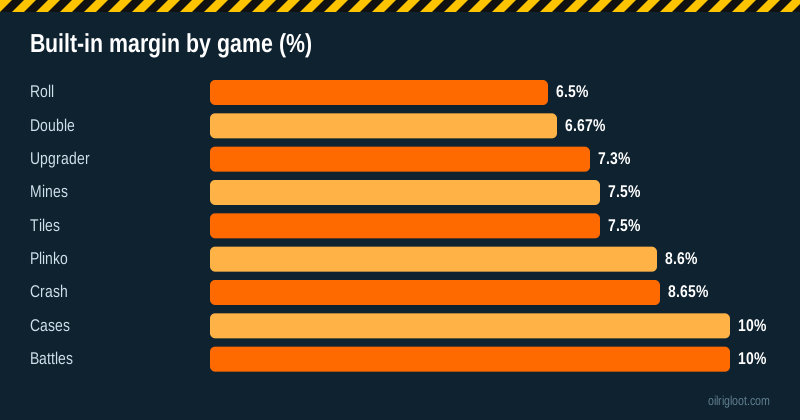
The house edge is the share of each bet the site keeps on average. RustClash lists its figures in its FAQ:
| Game | Published house edge | Average kept per 100 gems wagered |
|---|---|---|
| Roll | 6.5% | 6.5 gems |
| Double | 6.67% | 6.67 gems |
| Upgrader | 7.3% | 7.3 gems |
| Mines | 7.5% | 7.5 gems |
| Tiles | 7.5% | 7.5 gems |
| Plinko | 8.6% | 8.6 gems |
| Crash | 8.65% | 8.65 gems |
| Case Opening | 10% | 10 gems |
| Case Battles | 10% | 10 gems |
"Average" is doing the heavy lifting there. One player can win big and another can lose everything in a minute. The site doesn't care which, because across all players the totals drift toward the edge. That's the law of large numbers at work, and it's the same reason a real casino doesn't worry when someone hits a jackpot.
Why a small edge becomes big money
The edge applies to every bet, not every deposit. That's the part most people miss. If you deposit 100 gems and keep re-betting your balance, you might wager 500 or 1,000 gems before you're done, and the edge is taken from all of it.
A made-up example: a player deposits 100 gems and plays Double at 6.67%. They win some, lose some, and keep re-betting until they've wagered 1,500 gems in total. The average cost of that session is about 1,500 × 6.67% = 100 gems. In other words, on average the whole deposit is gone, even though each individual bet looked close to a coin flip. That's how a "small" edge empties a balance.
2. Case pricing
Case opening is the classic skin-site game. RustClash's rules say a case's price is set based on the value of the items inside. The edge is built into that relationship: the expected value of what comes out is less than what you pay to open. With a 10% edge, a case costing 10 gems returns about 9 gems in item value on average.
Most cases are top-heavy: a few expensive items with tiny odds, lots of cheap items with high odds. That's what makes them exciting, and it's also why most openings return less than the case price. You can see the extreme version in RustClash's free welcome case, where Scrap has a 98% chance and the top skin 0.01% (our welcome case odds page has the full table).
Sites with a case creator let players build their own cases with chosen items and odds, but the site still applies its edge to those cases too.
3. Case battles: the edge on every case, every player
In a case battle, several players open the same cases and the winner takes the pot. It feels like player against player, but each case in the battle is still a case with a 10% edge, so the site takes its cut from every opening by every player. A four-player battle with three cases each is twelve case openings, each with the edge built in. The winner's pot is what's left after that.
4. Fees on withdrawals and payments
The house edge isn't the only margin. Third-party reviews of RustClash mention a crypto withdrawal fee in the 2% to 5% range, which covers network costs and can also add margin. Payment processors charge sites for card deposits, and those costs are part of why sites push crypto and skins. Check the withdrawal screen for current fees; they can change.
5. The skin pricing gap
When you deposit skins, the site values them at a price. When you withdraw skins from the onsite store, the site prices those too. The store price of a skin may not match what you'd get selling the same skin elsewhere, and the gap between "price in" and "price out" can work in the site's favour. This varies by item and by site, so compare a few prices before you deposit or withdraw expensive items.
6. Rewards: the marketing budget that keeps players betting
Free cases, rakeback, rain, daily races and missions look like giveaways, and they do hand value back. But they're designed to keep you playing longer. Rakeback returns part of what you wager, so it rewards wagering more. Daily races pay the biggest wagerers, which encourages more volume. Daily level cases unlock as your level rises, and level rises with wagering. From the site's side, these rewards cost less than the extra house edge they generate. For how this plays out in one reward, see our breakdown of the RustClash daily race.
The free welcome cases are customer acquisition: a tiny cost per new player to get them through the door.
7. Sweepstakes coins and the free-to-play side
RustClash runs a sweepstakes model for the US with two currencies. Gold Coins are for play only and can be bought or claimed free from a faucet; they can't be redeemed. Gems are the prize currency that can be redeemed for skins or crypto. Gems can't be bought directly; the terms say they come as a bonus with Gold Coin purchases, daily bonuses, promotions or free postcard entries. So the real money comes in through Gold Coin purchases, with Gems attached as a bonus, and the edge applies when Gems are played. Our Gold Coins explainer covers how it fits together.
8. Affiliates and partners
Skin sites can't buy ads on Google or most social networks, so they rely on streamers, YouTubers and affiliate sites. RustClash's public affiliate program page lists revenue share deals of 30% to 45%, or CPA and hybrid deals depending on country. Revenue share means the affiliate gets a slice of the site's net revenue from players they referred, which is mostly the house edge on those players' bets.
Put plainly: when a referred player loses, the site and its affiliate both earn. We'd rather you know that than pretend otherwise. It's also why we keep pointing out the edge and telling you to treat this as entertainment money.
Sites also cross-promote sister brands. RustClash's Rewards page offers 0.5% cashback on Acebet for every purchase, and its chat promotes Acebet's slot battles, which keeps players inside the same group of sites.
9. Where the money goes
A skin site's revenue isn't all profit. It pays for:
- Affiliates and streamer deals.
- Payment processors and crypto custody (RustClash says it uses Fireblocks for crypto deposits).
- Skin inventory and trading bots to cover withdrawals.
- Rewards like rakeback, rain and races.
- Support, KYC and fraud checks, and development.
But the source of almost all of it is the same: the edge on player bets.
What this means for you as a player
- Expect to lose over time. The edge makes that the most likely outcome if you play long enough.
- Wagering volume matters more than deposit size. Re-betting your balance is what drains it.
- Pick lower-edge games if you play. Roll and Double cost less per bet than Cases and Battles. See our house edge comparison.
- Bonuses trim the cost, they don't flip it. Take free cases and rakeback, but don't wager more to chase them.
- Check results with provably fair tools to be sure each outcome wasn't changed (here's how to verify on RustClash). Fair and profitable for the house aren't opposites; a game can be both.
- Withdraw wins rather than leaving them on the site to be re-wagered.
Is it a scam, then?
A built-in margin isn't a scam; it's how every casino, sportsbook and lottery works. What makes a site trustworthy is whether it's honest about the margin, pays out when you win and lets you check results. RustClash publishes its edges and has provably fair checks, but it holds no gambling licence and player reviews mention KYC delays and account closures. Read our is RustClash legit? check and decide for yourself.
Skin gambling is for adults only (18+ or your local age of majority), and RustClash isn't available in Idaho, Montana, Michigan, Nevada or Washington. If it stops being fun, stop. In the US call or text 1-800-GAMBLER, and see our responsible gambling page.