RustClash Double Strategy: The Maths Behind Every Spin
There's no RustClash Double strategy that beats the house: the published edge is 6.67% on every spin, whatever you bet on. What strategy *can* do is control how fast you lose, how big your swings are and when you stop. That's the honest version, and it's the only one that keeps you out of trouble.
Below: how Double's maths works, why systems like Martingale fail, and a simple, sensible way to play if you're going to play.
How Double works
Double is RustClash's roulette-style game. A wheel or strip spins and lands on a colour. You bet on which colour comes up. The site publishes a 6.67% house edge for Double.
That 6.67% figure matches the classic skin-site layout exactly: 15 slots, 7 red and 7 black paying 2x, and 1 green paying 14x. Check the wheel on the site to confirm the current layout. With that layout:
- Red: 7/15 chance × 2x = 0.9333 back per $1 → 6.67% edge.
- Black: same.
- Green: 1/15 chance × 14x = 0.9333 back per $1 → 6.67% edge.
So every bet has the same edge. Green isn't "better value"; it just wins less often and pays more when it does.
Why every "system" fails
Martingale (double after a loss)
The idea: bet $1 on red; if you lose, bet $2; then $4; and so on. When you finally win, you recover all losses plus $1.
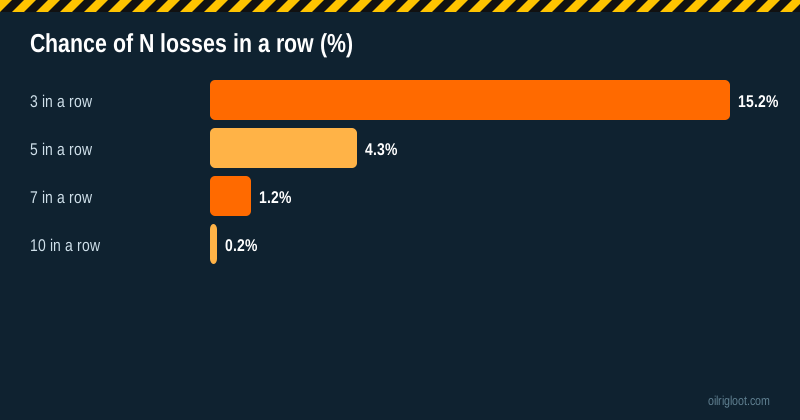
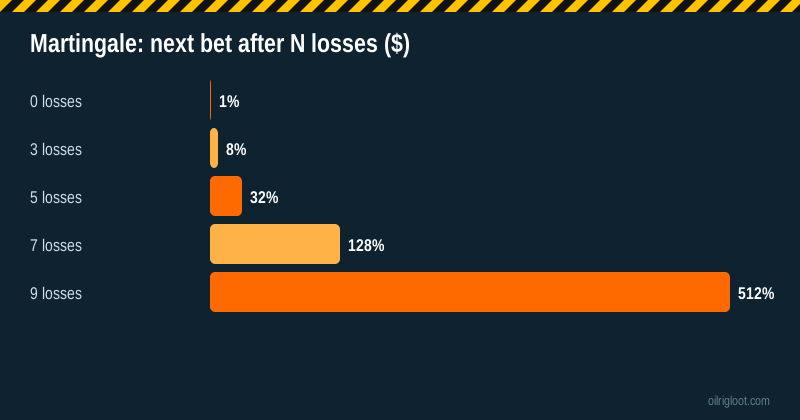
The problem: losing streaks happen more than you think, and bets grow fast. Made-up example starting at $1:
| Losses in a row | Next bet | Total lost so far |
|---|---|---|
| 3 | $8 | $7 |
| 5 | $32 | $31 |
| 7 | $128 | $127 |
| 9 | $512 | $511 |
On a 7-in-15 colour bet, the chance of losing 7 in a row is about 1.2%. Play a few hundred rounds and you'll likely see it. One bad streak wipes out hundreds of $1 wins, and the 6.67% edge is still there underneath.
Reverse Martingale (Paroli)
Double after a win, reset after a loss. It feels safer because you risk winnings instead of your bankroll. It just changes the shape of results: lots of small losses, occasional bigger wins. Same 6.67% edge.
"Wait for a streak, then bet the other colour"
After six reds, betting black because "it's due" is the gambler's fallacy. Each spin is independent and provably fair. The wheel has no memory.
Pattern tracking
The history bar showing the last 100 results is fun to look at but tells you nothing about the next spin. Seeds are committed in advance; the results aren't influenced by past rolls.
What actually helps
1. Flat bets, small units
Bet the same small amount every spin, around 1% to 2% of your session budget. Made-up example: with a $50 budget, bet $0.50 to $1. This keeps variance manageable and the session long.
2. A hard stop-loss
Decide in advance: "If I'm down $X, I stop." Then actually stop. This is the single most effective "strategy" in any negative-edge game.
3. A win goal (optional)
"If I'm up 50%, I withdraw." Win goals don't change the maths, but they turn lucky sessions into money in your wallet instead of money you give back.
4. Time limits
Double rounds are quick. Set a 30-minute timer. When it rings, take a break.
5. Colour vs green: pick your variance
- Colours: frequent small wins and losses. Lower variance.
- Green: long dry spells, occasional big hits. Higher variance.
Same edge either way. Choose what suits your budget and nerves.
Using rakeback and the 5% boost
These don't beat the edge, but they soften it:
- Rakeback (daily, weekly, monthly) returns a slice of what you wager.
- The 5% deposit boost via invite adds to your first and later deposits (third parties report up to $100 per deposit).
Don't wager extra to chase rakeback. You'll lose more to the edge than rakeback returns.
Double vs other RustClash games
| Game | Published edge |
|---|---|
| Roll | 6.5% |
| Double | 6.67% |
| Upgrader | 7.3% |
| Mines / Tiles | 7.5% |
| Plinko | 8.6% |
| Crash | 8.65% |
| Cases / Battles | 10% |
Double is among the lowest-edge games on the site. If you play RustClash and want your budget to last, Roll and Double are the best value. More in lowest house edge.
Verify your spins
Double is provably fair. If a run feels suspicious, rotate your seed and check a few spins with our provably fair guide.
Red flags in your own play
Stop and take a break if you notice:
- Doubling bets to "win it back".
- Depositing again in the same session after hitting your stop-loss.
- Thinking you've found a pattern.
- Playing when angry, tired or drunk.
Help: 1-800-GAMBLER (US), BeGambleAware (UK), our help page.
A sensible Double session (made-up example)
Invented example of a disciplined session:
- Budget: $40 for the week. Tonight's session: $20.
- Unit: $0.40 flat on a colour.
- Stop-loss: down $20 (the whole session budget).
- Win goal: up $10, then withdraw $10.
- Timer: 30 minutes.
Over 50 spins at $0.40 ($20 wagered), the expected loss at 6.67% is about $1.33. Actual results will swing either way, but the structure keeps the downside fixed and the time bounded. That's what "strategy" really means in Double.
Myths we hear about Double
"Bet when the chat is quiet; the site pays out less when lots of people bet." No. Your roll comes from seeds, not from how many players are on.
"Switch colours after two losses." Changes nothing. Each colour has the same chance every spin.
"Big bets get worse rolls." Bet size isn't part of the provably fair formula. It changes how much you win or lose, not the result.
"Green comes every 15 spins on average, so wait 14 and then bet green." On average green hits once in 15 spins, but it can go 40 or 50 spins without appearing, and it can hit twice in a row. Waiting doesn't raise the odds of the next spin.
How Double fits into a full night on RustClash
If you split a session across games, Double is a good "base" game because of its lower edge and simple bets. A sensible order (made-up example): open your free daily level case if you have one, play a few Double spins at flat stakes, and treat higher-edge modes like cases and battles as the occasional treat rather than the main event. The biggest losses tend to come from switching to high-edge, high-variance games late in a session when you're trying to win back what's gone. Decide your games before you start, not when you're down.
Bet sizing table (made-up examples)
A simple way to pick your unit: divide your session budget by 50 to 100. That gives you room for normal swings without one bad run ending the night.
| Session budget | Unit (1% to 2%) | Spins before budget is at risk |
|---|---|---|
| $10 | $0.10 to $0.20 | 50 to 100 |
| $25 | $0.25 to $0.50 | 50 to 100 |
| $50 | $0.50 to $1 | 50 to 100 |
| $100 | $1 to $2 | 50 to 100 |
These are made-up examples, not advice to spend any amount. The point is proportion: small units, long sessions, fixed downside.
Double and rakeback: a realistic picture
Rakeback returns part of the house's take from your wagering. It's a nice cushion, but it can't turn Double into a winning game: if it did, the site would go broke. Treat rakeback as a small discount on entertainment you were going to buy anyway, not as income.
The one-line strategy to remember
Small flat bets, a fixed budget, a timer, and leave when either runs out. Every "system" beyond that is either a different way to lose the same 6.67% or a faster way to lose more. If you notice yourself reaching for a system after a losing run, that's the moment to stop for the night.
Is Double better than cases for a casual player?
On cost, yes: 6.67% against 10%. On fun, that's personal. Some players find Double repetitive and only enjoy the case-opening moment. If that's you, open fewer, cheaper cases and accept the higher edge as the price of the thing you enjoy, rather than grinding Double you don't like to "save" money.
Check the wheel layout
Our maths assumes the classic 15-slot layout that matches the published 6.67% edge. If the wheel you see has a different layout or extra bet types, use the payouts shown on screen and the same method: chance × payout tells you what you get back on average.
Verdict
The best RustClash Double strategy is boring: flat small bets, a hard stop-loss, a time limit and an optional win goal. No system beats the 6.67% edge, and Martingale is a fast way to blow a bankroll. Double is one of RustClash's lowest-edge games, so if you play, it's a reasonable choice, 18+ and within a budget.