Is RustClash Rigged? Separating Bad Luck From a Bad Site
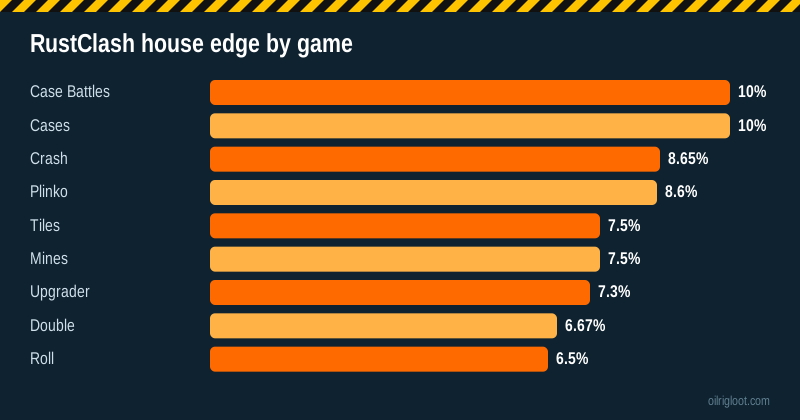
RustClash isn't rigged in the sense most Reddit posts mean, where the site secretly decides you'll lose. It is built to win over time, though, and it tells you exactly by how much. That's the part most angry threads miss: a house edge is the business model of every case site, and RustClash publishes its edge for every game.
Let's go through what "rigged" actually means, what the numbers say, and how to check results yourself so you're not relying on vibes.
What people mean by "rigged"
When someone posts "RustClash is rigged" on Reddit, it's usually one of three claims:
- "The odds are worse than they say." The site shows one chance of a rare skin but quietly uses another.
- "It knows when I bet big." Results change depending on how much you bet, or whether you're on a heater.
- "It's fine at first, then they turn it off." A "honeymoon" where new accounts win, then the site squeezes them.
Each of these is a claim that individual results are being manipulated. That's different from the house edge, which is a fixed, disclosed cut built into every game.
The published house edge: the honest "rig"
Here's what RustClash publishes as its house edge per game, as we last checked:
| Game | House edge | What you get back on average per $100 played |
|---|---|---|
| Roll | 6.5% | about $93.50 |
| Double | 6.67% | about $93.33 |
| Upgrader | 7.3% | about $92.70 |
| Mines | 7.5% | about $92.50 |
| Tiles | 7.5% | about $92.50 |
| Plinko | 8.6% | about $91.40 |
| Crash | 8.65% | about $91.35 |
| Cases | 10% | about $90 |
| Case Battles | 10% | about $90 |
Those "per $100" figures are made-up examples to show the maths, not a promise of what you'll get in any session. In a short session you can easily be way up or way down. Over thousands of bets, results drift toward that number.
So yes, the games are designed so the house wins. That's not hidden. It's the same idea as a slot machine's RTP, just written the other way round.
Why losing streaks feel rigged
Our brains are bad at randomness. A few things make fair games feel crooked:
- High-variance games. Case Battles and cases are decided by rare drops. On a case where the top skin has a tiny chance, you can open dozens without seeing anything good. That's not rigging; that's what tiny odds look like.
- Remembering losses more. A five-loss run on Double sticks in your head. The five-win runs blur together.
- Chasing. Bigger bets after losses mean your biggest bets often happen during your worst run. Then the loss looks huge.
- The gambler's fallacy. After eight reds in Double, black isn't "due". Each roll is independent.
A quick made-up example: imagine Double's black has close to a 50/50 chance per roll. The chance of losing 6 in a row is about 1 in 64. If you play a few hundred rolls a week, you'll see that streak several times. It'll feel personal. It isn't.
How provably fair actually stops rigging
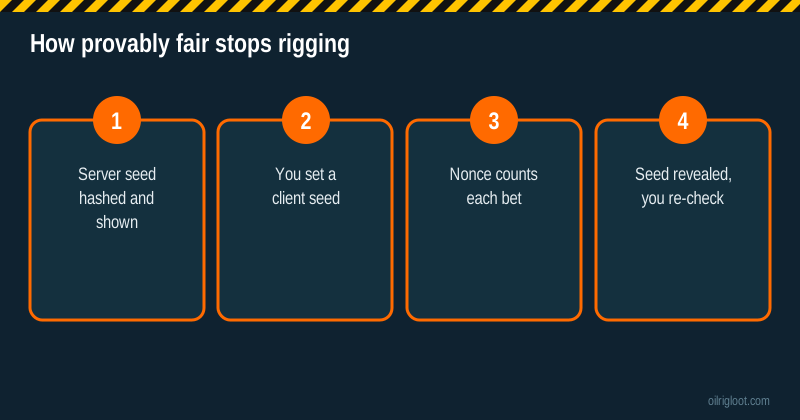
RustClash uses a provably fair system, as do most serious skin sites. In plain English:
- Before you bet, the site generates a secret server seed and shows you its hash (a fingerprint). It can't change the seed later without the fingerprint changing.
- You have a client seed you can set yourself.
- Each bet adds a nonce (a counter: 1, 2, 3...).
- The result comes from combining those three. Afterwards, when you rotate seeds, the site reveals the server seed. You hash it yourself, confirm it matches the fingerprint you saw, and re-calculate your rolls.
If RustClash changed a result after seeing your bet, the maths wouldn't match. That's why "it knows when I bet big" doesn't hold up for provably fair rounds. We walk through the actual checking steps in how to verify RustClash's provably fair results.
A made-up example: how variance looks over a night
Picture a player with a $50 budget who plays Double at $1 a spin, always on the near-50/50 colour. Made-up example, not real data:
| Spins played | What often happens | What the house edge predicts |
|---|---|---|
| 20 | Anywhere from -$10 to +$10 | about -$1.33 |
| 100 | Usually within about -$20 to +$15 | about -$6.67 |
| 500 | Losing in most nights | about -$33 |
| 2,000 | Almost always losing | about -$133 (more than the budget) |
Short sessions feel random because they are. Long sessions feel "rigged" because the edge finally shows up. Nothing about the site changed between spin 20 and spin 2,000; the maths just had time to work.
Battles, upgrades and the "it always just misses" feeling
Two games create the strongest rigging suspicion, so they deserve a special note.
Case battles. In a 2-player or 4-player battle, one big drop usually decides the winner. If you're in battles where the top item is a 0.5% hit, you'll watch other people hit it while you get scrap, over and over. With more players per battle, your chance of being the one who hits falls further. Remember battles also carry a 10% published edge on top of the case values.
Upgrader. You pick a skin to risk and a target, and the site shows your exact win chance. A 30% upgrade fails 70% of the time. Seeing the pointer stop just short of the zone looks like a near miss, but it's just a visual of a number that was already decided by the seeds. Near misses are a well-known psychological hook in all gambling design, so treat them as a cue to slow down, not to try again. Our upgrader odds guide runs the numbers.
Should you trust third-party "RustClash is rigged" videos?
You'll also find YouTube and TikTok clips claiming to expose rigging. Before you believe one, look for three things: did they show the server seed hash before the session, did they reveal the seed after, and did they re-calculate the rolls on screen? If a video skips that, it's a story about bad luck with dramatic music. Sponsored "I turned $5 into $500" clips deserve the same treatment in the other direction: they're often using promo balances supplied by the site.
What provably fair does NOT protect
Be clear-eyed. Provably fair proves the roll wasn't changed. It doesn't prove:
- The prize table is generous. A case can be fair and still terrible value. The house edge lives in the item values and odds.
- Item prices are accurate. The gem value of a skin is set by the site. Compare with Steam Market or third-party price checkers if it matters to you.
- Withdrawals are quick. That's about the operator's processes, KYC and trade holds, not fairness.
Checking the Reddit claims one by one
"The odds are worse than shown." Possible in theory on any site, but provably fair plus public odds make it testable. Players who've posted seed checks haven't shown mismatches. We haven't seen a credible, verified case for RustClash.
"It knows when I bet big." Not under provably fair: the seed is locked before your bet. Bet size doesn't enter the roll formula.
"Honeymoon then squeeze." This is the classic illusion. New players who win early stick around and post; when they regress to the house edge, it feels like the site "turned it off". There's no evidence of account-level odds changes, and doing that would break seed verification.
"Battles are rigged against the creator/joiner." Battle results come from the same seeded rolls for every player slot. Seat position doesn't change the maths.
Signs a skin site really might be rigged
So you can judge any site, not just this one:
- No published house edge or odds.
- No provably fair system, or one where you can't set your own client seed.
- Seeds that are never revealed, or a "verify" page that doesn't actually let you re-calculate.
- No named company or owner.
- Lots of complaints about withdrawals refused for no stated reason.
RustClash publishes its edge, has a named operator (Rust Clash Entertainment Ltd, Cyprus) and runs provably fair. Its real weaknesses are elsewhere: no gambling licence, KYC requests at cash-out, and Valve's rules on skin gambling. See is RustClash legit for that side.
How to protect yourself from "rigged" feelings
- Pick lower-edge games if you play at all. Roll (6.5%) and Double (6.67%) keep less than Cases and Battles (10%). See Rust gambling sites with the lowest house edge.
- Set a stop-loss. Decide the amount you'll lose today before you start. When it's gone, close the tab.
- Don't chase. If you're doubling bets to win back losses, stop. That's where the worst sessions come from.
- Verify a few rolls. Doing it once kills a lot of the paranoia.
- Start with the freebies. Open the 3 free welcome cases to see the system, knowing they're mostly scrap.
Verdict
RustClash isn't rigged in the "secretly changes your results" sense, and you can check it yourself with provably fair. It is designed to keep between 6.5% and 10% of what you play over time, and that's exactly what it says on the tin. If that feels rigged, it's a sign skin gambling may not be for you, and that's a perfectly good conclusion. 18+ only; if it stops being fun, call 1-800-GAMBLER.