Rust Gambling Wheel Strategy
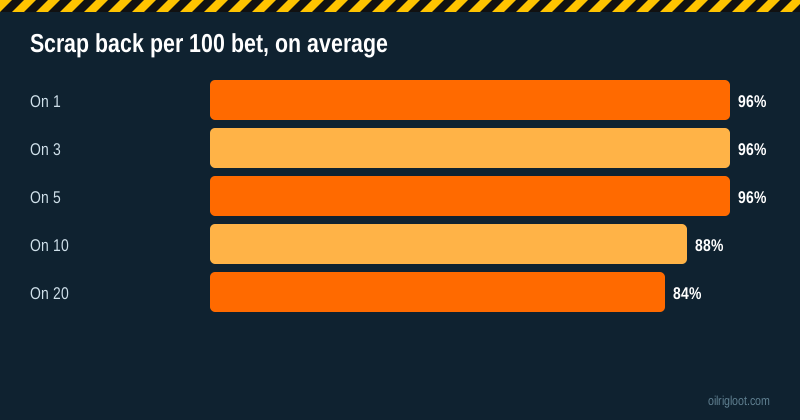
The best "strategy" for Rust's Bandit Camp gambling wheel is simple: bet on 1, 3 or 5, keep your bets small compared with your scrap, and stop at a number you set before you sit down. Those three numbers all return about 96 scrap for every 100 bet on average. The 10 and 20 look tempting but return less. No split-bet system, pattern or timing trick changes that, because each spin is independent and the wheel's maths is fixed.
Below is the full breakdown, why popular "systems" don't work, and how the wheel compares with Double on real-money skin sites. The in-game wheel uses scrap; real-money skin sites are a different thing entirely and are 18+ only.
How the Bandit Camp wheel works
The wheel sits in the casino at Bandit Camp, the safe-zone monument. You sit at one of the seats facing the wheel, put scrap on one or more numbers, and wait for the spin. Guides commonly say it spins about every 45 seconds. If the pointer lands on a number you bet on, you get paid.
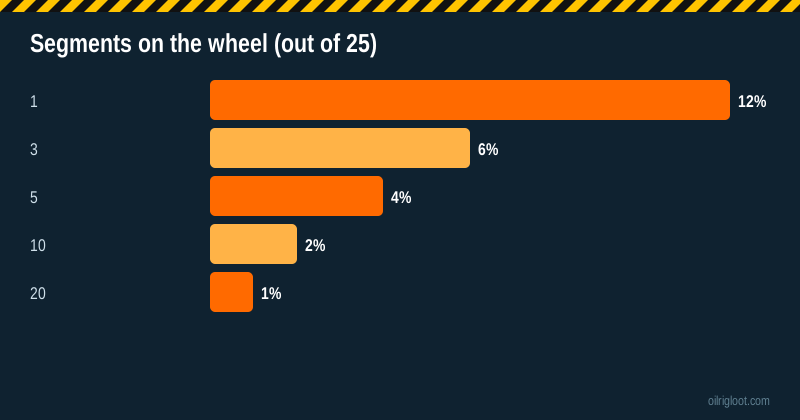
Players have counted the wheel many times. The widely accepted layout is 25 segments:
| Number | Segments | Chance per spin | Common payout (incl. your bet) | Profit on a 100 scrap win |
|---|---|---|---|---|
| 1 | 12 | 48% | 2x | 100 |
| 3 | 6 | 24% | 4x | 300 |
| 5 | 4 | 16% | 6x | 500 |
| 10 | 2 | 8% | 11x | 1,000 |
| 20 | 1 | 4% | 21x | 2,000 |
The way to read it: the number is the multiplier on your bet, and you also get your bet back. So 100 scrap on 5 that hits pays 500 profit plus your 100 back, 600 total. Some older guides list higher payouts on 10 and 20. Facepunch has tweaked the game many times, so if the in-game display shows different multipliers, use those numbers with the same method below.
The expected return on each bet
Expected return is what you get back on average per bet over many spins. It's just chance × payout:
- 1: 48% × 2 = 0.96 → 96 scrap back per 100 bet
- 3: 24% × 4 = 0.96 → 96 per 100
- 5: 16% × 6 = 0.96 → 96 per 100
- 10: 8% × 11 = 0.88 → 88 per 100
- 20: 4% × 21 = 0.84 → 84 per 100
So the wheel keeps about 4% of what you bet on 1, 3 or 5, about 12% on 10, and about 16% on 20. Those are the house edges. In plain terms: 1, 3 and 5 are equally good (or equally bad), and 10 and 20 are worse value, even though the wins look bigger.
Why 1, 3 and 5 are the same "value" but feel very different
All three cost about 4% on average, but they feel completely different to play. That's volatility.
| Bet | How often you win | What a losing run looks like | Feel |
|---|---|---|---|
| 1 | About every other spin | Short | Slow, steady, small swings |
| 3 | About 1 in 4 spins | Medium | Bigger swings |
| 5 | About 1 in 6 spins | Long dry spells | Big swings, big hits |
Made-up example: you have 1,000 scrap and bet 50 a spin. On 1, it would take a very unusual run to go broke quickly. On 5, losing 10 spins in a row isn't rare at all (a 16% chance means about 84% chance of missing each spin, and 0.84 to the power of 10 is roughly 17%). Same average cost, very different ride. Pick the one that matches how much swing you can stomach.
Do split bets work?
A popular idea is to spread scrap across several numbers, for example half on 1 and half on 3, or a mix on 3, 5, 10 and 20. Players say it feels like you "almost always win something." That's true, but you're also almost always losing part of your spread on the numbers that didn't hit.
The maths: the expected return of a split is just the weighted average of its parts. A split across only 1, 3 and 5 still returns 96%. Add any scrap to 10 or 20 and the average drops below 96%. One Reddit user even ran every combination through a program and couldn't find anything above 96%. Splits change how smooth your results feel, never the average.
Myths about the wheel
"It's due to hit 20." No. Each spin is independent. A wheel that hasn't landed on 20 for 50 spins has the same 4% chance next spin.
"Watch the pattern." Short streaks look like patterns because humans are wired to see them. Recording a few dozen spins can't predict the next one.
"Double after a loss." That's the Martingale system. It feels safe until a long losing run hits and your bet size explodes. On the wheel, a long run of missing 1 isn't rare enough to rely on. Our Double strategy guide shows how fast Martingale bets grow.
"Certain seats are luckier." All seats see the same spin.
Scrap budgeting that actually helps
Since you can't beat the average, the only real strategy is managing your scrap.
- Decide what the scrap is for. If you need 1,250 scrap for a tier 3 workbench or a key blueprint, don't gamble that pile. Bet only spare scrap.
- Bet small per spin. A good rule is 1% to 5% of your gambling scrap per spin, so a bad run doesn't wipe you out.
- Set a stop-win and stop-loss. For example, leave if you double your starting pile or lose half of it.
- Remember the clock. At one spin every 45 seconds, an hour is about 80 spins. At 100 scrap a spin on 1, the average cost is about 4 scrap per spin, or about 320 scrap an hour. That's scrap you could have spent on components.
- Watch your back. Bandit Camp is a safe zone, but the walk home isn't. A big win you carry out in your inventory is a target. Plan your route and log out safely.
A worked session, start to finish
Here's a made-up session to show how the numbers play out. You arrive with 2,000 spare scrap and set two rules: bet 50 a spin on 3, leave at 3,000 or at 1,000.
Spins 1 to 6 miss, so you're down 300. Spin 7 hits 3, paying 150 profit plus your 50 back. Spins 8 to 15 bring one more hit and seven misses. After 15 spins you're down about 250 scrap. Then a run of three hits in nine spins puts you back near even. That's what a 24% bet feels like: long gaps, then clumps.
Over a full hour, about 80 spins at 50 scrap is 4,000 scrap wagered. At a 4% average cost, you'd expect to be down around 160 scrap, though any single hour could finish 600 up or 600 down. If you hit your 3,000 stop-win early, the best move is the boring one: get up, walk home carefully and spend it.
Gambling for a specific item
Sometimes players gamble because they're short of scrap for a specific item or blueprint. If you're 200 short, a single bet on 1 gives you about a 48% shot at doubling a stake. Betting your whole pile on 5 gives you a 16% chance at six times the stake. Both cost the same 4% on average, but the second is far more likely to leave you with nothing. If you really need the item, farming the missing scrap from barrels and recycling components is slower but certain.
Bandit Camp wheel vs Double on skin sites
Many Rust players who enjoy the in-game wheel end up curious about Double on real-money skin sites. They're related, but the stakes are not the same.
| Bandit Camp wheel | RustClash Double | |
|---|---|---|
| Where | Inside the Rust game | Separate real-money website |
| What you bet | Scrap (no cash value) | Gems tied to real money, skins or crypto |
| Published or counted edge | About 4% on 1, 3 or 5 | 6.67% published |
| Age | Game rating | 18+ (or local age of majority) |
| Can you cash out | No | Yes, as Rust skins or crypto |
| Fairness check | Game code | Provably fair tools you can run |
Two honest points. First, the in-game wheel is actually cheaper per bet than Double. Second, scrap losses cost you game progress, while Double losses cost you real money. If you try Double, start with the free welcome cases, set a real-money budget you're fine losing, and read our house edge comparison and provably fair guide first. RustClash isn't available in Idaho, Montana, Michigan, Nevada or Washington and holds no gambling licence.
Quick strategy summary
- Bet on 1, 3 or 5. They all return about 96%.
- Avoid 10 and 20 unless you're happy paying more for the thrill.
- Splits don't improve the average; they just smooth the ride.
- Bet small compared with your pile and set stop points.
- Never gamble scrap you need for progression.
- Real-money wheel games are a separate decision, for adults only.
If gambling of any kind, in-game or real money, is getting out of hand, take a break. In the US call or text 1-800-GAMBLER; in the UK call 0808 8020 133. More help is on our responsible gambling page.