RustClash Daily Race Rewards Explained
RustClash's daily race is a wagering leaderboard: every bet you place adds to your score, the highest wagerers when the timer hits zero split a prize pool, and a fresh race starts. RustClash's homepage advertises it as a "2K Daily Race" where you can "win up to 1,000 Gems". It's free to enter in the sense that you don't sign up separately, but the only way to climb is to bet, and that's the catch this page is mostly about.
RustClash is 18+ (or your local age of majority), not available in Idaho, Montana, Michigan, Nevada or Washington, and holds no gambling licence.
How the race works, step by step
From what RustClash shows on its site and what third-party reviews describe, the race runs like this:
- Every wager counts. Bets on RustClash games add to your race score as you play.
- A live leaderboard ranks everyone. You can see who's on top and roughly what it takes to get a spot.
- A countdown runs. When it hits zero, the race ends and prizes are paid to winners' balances.
- A new race starts. Scores reset and everyone begins from zero again.
Some details vary depending on which review you read. Some describe the top five wagerers getting paid, with first place at 1,000 and fifth at 250. Others describe a longer prize list. One review says the race resets at midnight UTC. We haven't confirmed the exact prize split or reset time ourselves, so the honest advice is: open the Race page from RustClash's footer and read the live table before you plan anything around it.
Third-party reviews also say you don't need KYC to take part, but you do need a linked Steam account. RustClash's terms say it decides contest results at its sole discretion and can adjust for errors or irregularities.
The maths nobody puts on the race banner
Here's the bit that matters. To finish high on a wager race you don't need to win, you need to bet a lot. And every bet carries the house edge. RustClash publishes its edges: 6.5% on Roll, 6.67% on Double, 7.3% on Upgrader, 7.5% on Mines and Tiles, 8.6% on Plinko, 8.65% on Crash and 10% on Cases and Battles.
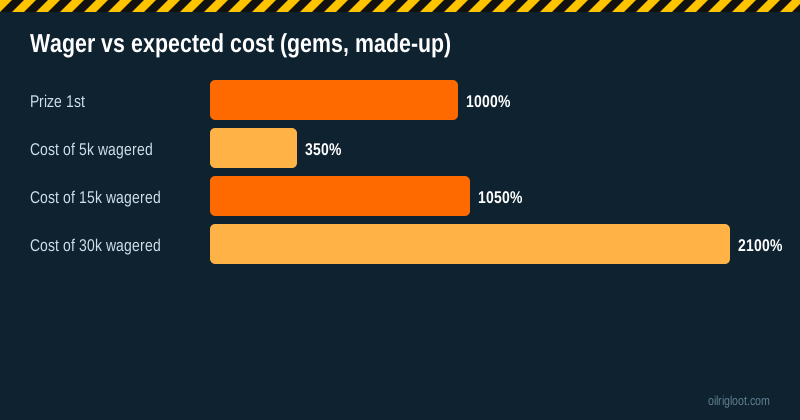
The average cost of wagering is roughly the amount wagered times the edge. So, a made-up example using a 7% edge:
| Amount wagered in a day | Average cost at 7% edge | Compared with a 1,000 prize |
|---|---|---|
| 5,000 gems | about 350 gems | Prize would more than cover it, if you won it |
| 15,000 gems | about 1,050 gems | Roughly break-even even if you win first |
| 30,000 gems | about 2,100 gems | Lose on average even with first place |
These are averages, not predictions. Any single day can go much better or much worse. But the shape is clear: if the leaderboard on a given day needs tens of thousands wagered to reach a paid spot, chasing it costs more than the prize, on average. And if you push and miss the cut, you've paid the cost with no prize at all.
That's why we'd only see the race as a nice extra for people who already wager heavily, never as a reason to bet more.
Which games help your race score most?
If the race counts all wagers equally (check the race page, as rules can differ), then from a cost point of view the lowest-edge games are the cheapest way to build wager volume. Roll at 6.5% and Double at 6.67% cost less per gem wagered than Cases or Battles at 10%. Our house edge comparison has the full list, and our Double strategy guide explains why no betting system beats the edge.
There's a trap here, though. Low-edge games with near 50/50 outcomes let you churn volume fast, and fast churn is exactly how sessions get out of hand. Speed isn't your friend.
Daily race vs RustClash's other rewards
The race isn't the only reward on RustClash, and for most players it's the least useful one. Here's how the rewards on the Rewards page stack up.
| Reward | What it is | Who it suits |
|---|---|---|
| 3 free welcome cases | No-deposit cases for new accounts via an invite; needs Discord linked | Everyone new; odds are mostly Scrap |
| 5% deposit boost | Extra on your next deposit after redeeming an affiliate code | Anyone about to deposit anyway |
| Daily level cases | A free case each day from cases you've unlocked by level (5, 10, 20 up to 200) | Regular players |
| Rakeback | Daily, weekly and monthly return on what you wager | Regular players |
| Rain | A gem pot shared every 30 minutes; needs KYC or level 10+ | Players hanging around chat |
| Missions | Tasks with rewards (the page shows 0/30 progress) | Players who like goals |
| Daily race | Top wagerers split the pool | High-volume players only |
| Gold Coins faucet | 1,000 Gold Coins when you run out; for free play only | Anyone learning games without risk |
For a casual player, the welcome cases, daily cases and rakeback deliver value without asking you to change how you play. The race is the opposite: it rewards changing how you play. That's worth knowing. If you're new, start with our welcome case odds and no-deposit promo guide.
A made-up week: two players, same budget
Picture two players who each set aside the equivalent of 100 gems a day for a week.
The first plays the way they normally would. Some days they're up, some days down. They open their free daily case once they've reached level 5, collect rakeback at the end of the week and never look at the race board. On average they'll lose something close to their total wagering times the edge, and the rakeback hands a slice of that back.
The second decides to chase a race spot. To get near the board they need to churn their 100 gems over and over, re-betting winnings to build wager volume. Their wagering for the week ends up many times larger than the first player's, so their average cost is many times larger too. If they snag a paid spot once, it may cover part of that. If they don't, they've paid far more than the first player for the same week of play.
Same budget, very different results. The difference is simply how much gets wagered, because that's what the house edge charges on.
The race and rakeback together
One thing the race does have going for it: the wagering you do for it also counts toward rakeback, so the two stack. But rakeback hands back only a small share of what heavy wagering costs on average, so it softens the cost of heavy wagering rather than removing it. Stacking two rewards on top of a loss still leaves a loss, on average.
Signs the race is changing your behaviour
Wager races are designed to keep people playing. Watch for these:
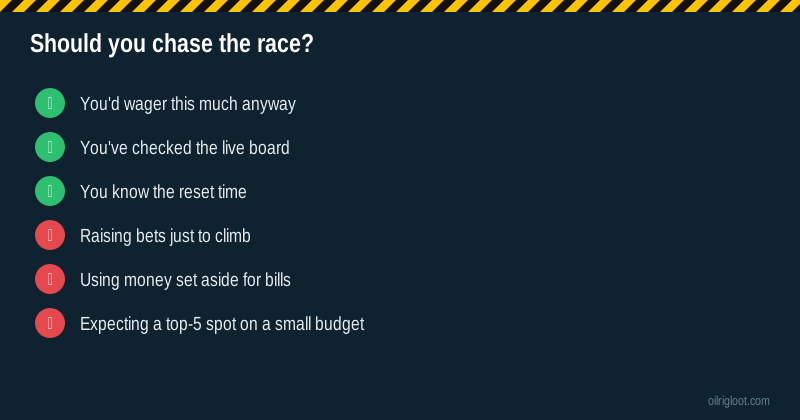
- You check the leaderboard more than you check your balance.
- You keep playing "just to hold your spot" after you'd normally stop.
- You raise your bet size near the end of the countdown.
- You deposit again to stay in a paid position.
- You feel cheated when someone overtakes you in the last minutes.
If two or more of these sound familiar, take a break from the site. Set a limit and stick to it.
Tips if you're going to take part anyway
- Decide your normal session budget first and ignore the race when setting it.
- Look at the board early to see what wager level the paid spots are sitting at. If it's far above your budget, forget the race for the day.
- Never deposit to stay on the board.
- Withdraw race winnings rather than wagering them straight back. Our withdrawal times guide explains what to expect.
- Read the terms on stacking. RustClash's terms list repeated farming or stacking of free rewards as prohibited conduct, so don't try running several accounts for races or free cases.
Is the race fair?
RustClash's games use a provably fair system you can check yourself (see how to verify a roll). The race is different: it's a leaderboard RustClash runs and judges. Its terms say it's the final judge of winners and can adjust results for errors. That's normal for this kind of contest, but it means there's no outside check if you disagree with a result. RustClash also holds no gambling licence, so its support team is the only place to raise a dispute.
Bottom line
The RustClash daily race pays the biggest wagerers each day, with up to 1,000 gems advertised for the top spot. For high-volume players already betting that much, it's a bonus. For everyone else, chasing it usually costs more than it pays because of the house edge. Take the free cases, daily cases and rakeback, and treat the race as something you notice, not something you chase.
If gambling isn't fun anymore, stop. In the US, call or text 1-800-GAMBLER; in the UK, call 0808 8020 133. Our responsible gambling page has more help.