RustClash Trustpilot Reviews 2026: The Patterns Behind the Stars
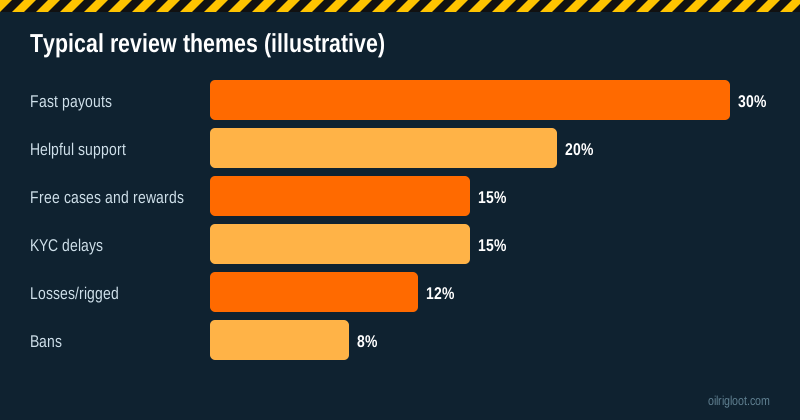
Trustpilot is useful for RustClash if you read the patterns, not the star average. Skin sites attract extreme reviews: delighted posts right after a big withdrawal and furious ones right after a losing streak. Somewhere in the middle are the reviews that actually tell you how the site treats people.
We went through the kinds of reviews RustClash gets in 2026 and sorted them into themes so you know what to expect before you sign up. The live score changes daily, so open the RustClash Trustpilot page alongside this guide.
How to read a skin-site Trustpilot score
Three things skew Trustpilot ratings for gambling sites:
- Review invites. Many operators send review invitations after a withdrawal. Happy customers get asked at their happiest moment, which pushes scores up.
- Rage reviews. Players who just lost often post a one-star "SCAM" within minutes. That pushes scores down.
- Volume over time. A site with thousands of reviews moves slowly; a few dozen reviews can swing a smaller site's score wildly.
So the headline number tells you less than you'd think. The detail in the reviews tells you much more.
Theme 1: Payouts and withdrawal speed
The most common positive theme for RustClash is quick crypto withdrawals. Reviewers who stuck to the rules (played through their deposit once, verified when asked) generally report receiving crypto or skins without drama.
What to watch for in these reviews:
- The method. Crypto withdrawals are typically fastest. Skin withdrawals can be slowed by Steam trade holds and item availability in the on-site store.
- The fee. Third-party reviewers report a crypto withdrawal fee of roughly 2% to 5%. If a reviewer is annoyed they got "less than expected", this is often why.
- The playthrough. A 1x playthrough on deposits before withdrawing is reported. People who deposit and immediately try to withdraw often hit this.
Full details are in our guides to withdrawal times and crypto withdrawals.
Theme 2: KYC and ID checks
The biggest source of genuine frustration is KYC. Common triggers mentioned in reviews and in RustClash's own rules:
- Withdrawing in crypto money that was deposited by card (ID needed).
- Unlocking the level-5 free case.
- Larger or unusual withdrawals.
KYC isn't a scam signal: it's how sites fight fraud and card chargebacks. But it does slow things down, and reviews that complain "they asked for ID after I won" are describing a real friction point. Our tip: if you plan to deposit by card and cash out in crypto, expect KYC and get it done early. See how long RustClash KYC takes.
Theme 3: Support quality
RustClash runs live chat support. Reviews are mixed in a predictable way: fast replies for simple questions, slower and more scripted replies for disputes. A good review signal is when the company replies on Trustpilot and the reviewer later updates their review after the issue is fixed.
Theme 4: Free cases and rewards
Plenty of reviews mention the 3 free welcome cases, daily level cases, rakeback, rain and races. Expect two camps:
- "Free stuff is great." Rakeback and daily cases are real perks for regular players.
- "Free cases are useless." Also fair. The welcome case gives Scrap worth 0.01 gems about 98% of the time, so most people get almost nothing. That's in the published odds. See what the welcome cases really contain.
Theme 5: "Rigged" and losing streaks
One-star "rigged" reviews usually describe big losses on case battles or Double. RustClash publishes its house edge (from 6.5% on Roll to 10% on cases and battles) and runs provably fair rounds. A losing review is a reminder that the edge is real, not evidence of manipulation. More in is RustClash rigged.
Theme 6: Bans and limited accounts
A smaller group of reviews say accounts were banned or balances held. When there's detail, the common reasons are:
- Multiple accounts to farm free cases.
- Playing from a restricted US state (Idaho, Montana, Michigan, Nevada, Washington) or using a VPN to hide location.
- Chargebacks on card deposits.
Those are against the terms on almost every site. If you're thinking about any of them: don't. It's the fastest way to lose a balance.
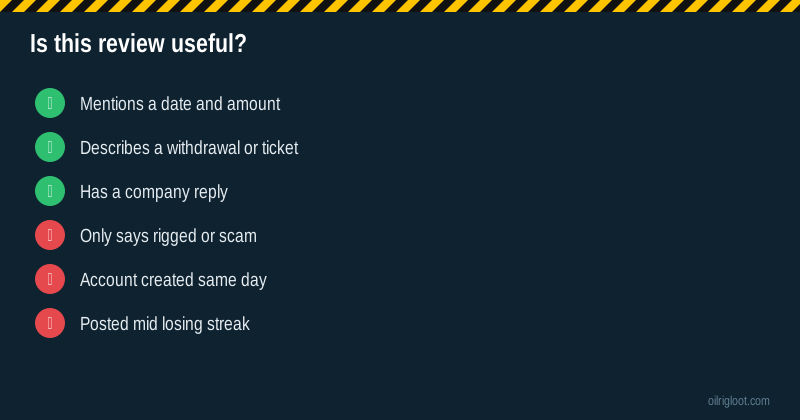
Reviews worth trusting vs reviews to skip
Trust more:
- Reviews with a date, amount, method and what happened next.
- Reviews updated after a support ticket.
- Reviewers with a history of reviewing other sites.
Trust less:
- One-liners: "scam", "best site ever".
- Reviews posted minutes after a big win or loss.
- Reviews that are clearly about a different site (it happens with Clash-branded sites).
What we'd do with this info
If you're deciding whether to try RustClash, the Trustpilot picture lines up with what we see elsewhere:
- Expect working withdrawals if you follow the rules, with possible KYC.
- Expect fees on crypto cash-outs and a 1x deposit playthrough.
- Expect the free welcome cases to be mostly scrap.
- Expect to lose over time; the house edge is published.
- Never play from a restricted state or with a VPN.
What the reviews say about the free rewards beyond the welcome cases
Regular players tend to review the ongoing perks more kindly than the welcome offer. The ones that come up most:
- Rakeback paid daily, weekly and monthly, which returns a slice of what you wager. It doesn't beat the house edge, but it softens it.
- Rain every 30 minutes in chat, which needs KYC or level 10+ to join.
- The daily race with a 2K prize pool for the top wagerers. Great if you were going to play anyway; a trap if it makes you play more.
- Daily level cases, missions and the Gold Coins faucet.
Reviewers who mention these usually play often. If you're a casual player, weight the welcome-offer reviews more, because those describe your experience.
Trustpilot vs Reddit vs review sites
Each source shows you a different slice of the truth, so use them together:
| Source | Best for | Weak spot |
|---|---|---|
| Trustpilot | Volume of payout and support experiences, company replies | Review invites and rage posts skew stars |
| Long, detailed threads and follow-ups in comments | Small sample, loudest voices win | |
| Review sites | Structured tests of deposits, withdrawals, fees | Many are affiliates (like us), so check their sources |
| RustClash's own terms | The actual rules: KYC, restricted states, playthrough | Written by the operator, in legal language |
When all four point the same way, you can be fairly confident. With RustClash, they agree on the basics: real payouts, KYC friction, crypto fees, mostly-scrap welcome cases, and a house edge that does exactly what it says.
If you need to leave a complaint yourself
If you end up with a real problem, a clear review gets better results than an angry one:
- Open a live chat ticket first and keep the ticket number.
- Wait a reasonable time for a reply (a couple of working days for complex issues like KYC).
- If it's still stuck, post a Trustpilot review with the date, the method, the amount and the ticket number. Keep it factual.
- Update your review if the issue is fixed. That helps other players more than anything.
Remember that we're not RustClash support and can't fix account issues, but we do read every correction email at editorial@oilrigloot.com and update our guides when patterns change.
Where reviews and our guides line up
When several detailed reviews complain about the same thing, we check it against RustClash's terms and update our guides. Right now the recurring friction points match what we already cover: KYC on card-to-crypto cash-outs, crypto withdrawal fees, Steam trade holds on skin deposits and the low value of the welcome cases.
Does Trustpilot cover rustclash.us.com too?
Some US players are steered to rustclash.us.com under the sweepstakes model. Reviews for the US site may be listed separately or mixed in. When you read a review, check which version the reviewer used, because payment options and prize redemption work differently under sweepstakes rules (Gold Coins for play, Gems as the prize currency). See RustClash sweepstakes Gold Coins explained.
A quick routine for checking reviews before you deposit
This takes five minutes and saves a lot of regret:
- Open the live Trustpilot page and filter to the last three months. Old reviews describe old rules.
- Read five one-star and five five-star reviews with real detail. Skip the one-liners.
- Note which complaints repeat: KYC, fees, slow skins, bans. Repeated complaints are the real risks.
- Check whether the company replies, and whether any reviewers updated their review after a fix.
- Compare with Reddit and with our own guides on the specific problem you're worried about.
If after that the risks still look acceptable for the amount you plan to deposit, you've done more homework than most players. If not, the free welcome cases let you try the site without spending anything.
Bottom line
RustClash's Trustpilot reviews look like those of a working, mid-to-large skin site: lots of satisfied payout reviews, a steady stream of KYC and losing-streak complaints, and a few bans tied to terms breaches. Read the detailed ones, ignore the rage posts and go in with a budget. 18+ only.